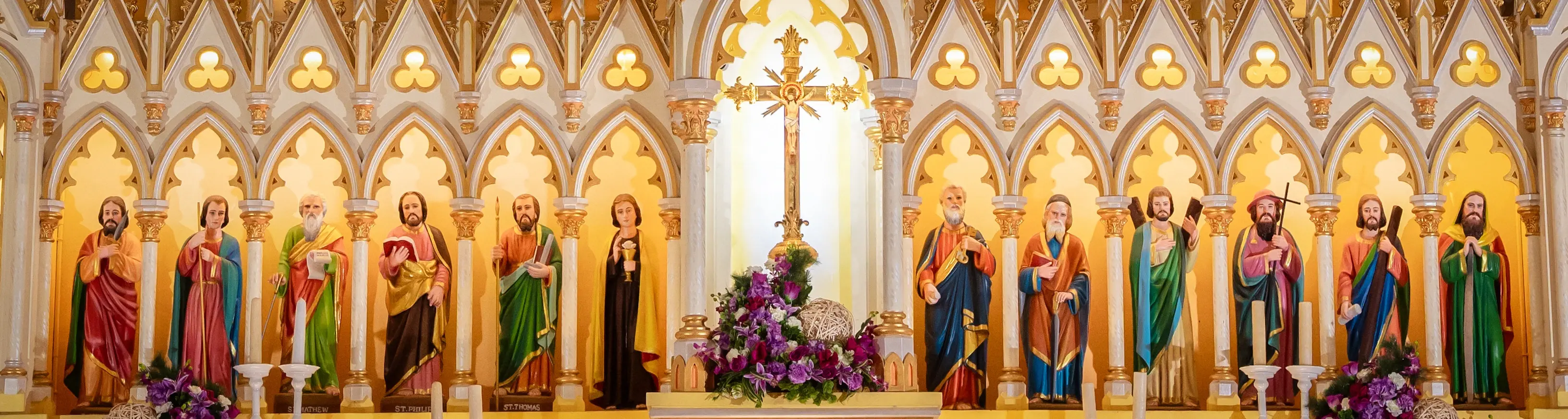
The Syro-Malabar Church is one of the 23 Eastern Catholic Churches in full communion with the Holy See. With a rich history spanning nearly 2,000 years, our Church traces its origins to Saint Thomas the Apostle, who evangelized India in the first century.

42-72 AD - St. Thomas the Apostle

December 21, 1923

December 16, 1992

October 10, 2017
The Syro-Malabar Church, together with other Churches of St. Thomas tradition in India, traces its origin to St. Thomas, 'the apostle of India' who evangelized India in the period between 42 and 72 AD during his missionary journeys. The community of St. Thomas Christians maintained their connection with the Church of the East in the Persian Empire throughout the medieval period.
In the seventh century, metropolitan status was granted to the Indian Church, indicating the acceptance of her autonomy. The community of St. Thomas Christians maintained their loyalty to the Persian Church while developing their unique Indian Christian identity.
From the 16th to 19th centuries, St. Thomas Christians came under Portuguese Padroado and Roman Propaganda Fide jurisdictions. The Synod of Diamper of 1599 brought significant changes to the oriental nature, Syriac liturgy, and Indian customs. The 'Coonan Cross Oath' of 1653 resulted in divisions within the St. Thomas Christian community.
The real modern period of the Syro-Malabar Church begins with the apostolic letter Quod Iam Pridem of May 20, 1887, by Pope Leo XIII, which established two vicariates of Trichur and Kottayam, separating Syrian Catholics from the Latins. In 1896, local bishops were appointed to the Syro-Malabar vicariates.
On December 21, 1923, Pope Pius XI established the Syro-Malabar hierarchy through the apostolic constitution Romani Pontifices. This gave tremendous impetus to the growth of Christianity in India.
Following the promulgation of the Code of Canons of the Eastern Churches in 1990, Pope John Paul II raised the Syro-Malabar Church to the status of a Major Archiepiscopal Sui Iuris Church on December 16, 1992, through the apostolic constitution Quae Maiori, with the title of Ernakulam-Angamaly.
On October 10, 2017, Pope Francis granted the Syro-Malabar Major Archiepiscopal Church jurisdiction for pastoral governance and evangelization all over India through the document Varietas ecclesiarum.

The Syro-Malabar liturgy preserves ancient East Syrian (Chaldean) traditions while incorporating Indian cultural elements.

With over 5 million faithful worldwide, the Syro-Malabar Church has eparchies in India, North America, Europe, and Australia.

Our Church maintains a vibrant tradition of prayer, fasting, and devotion rooted in both Eastern and Indian spirituality.

As an Eastern Catholic Church, we are in full communion with the Pope and the universal Catholic Church.
Join us in celebrating the Holy Qurbana and experience the beauty of our ancient liturgy